One Strike of the Pole Was the Whole Test
Nordic Tour Skating 🎮 Play: Long IceTwo days ago an iceboat spun me out because I skated onto a patch of wind-packed snow-ice I couldn’t read at forty klicks an hour. Today the ice-reading is not a hazard on the way to speed. It is the sport. So this post is about one thing done properly: how you decide whether a sheet of natural ice will hold you, before you commit your whole weight to it.
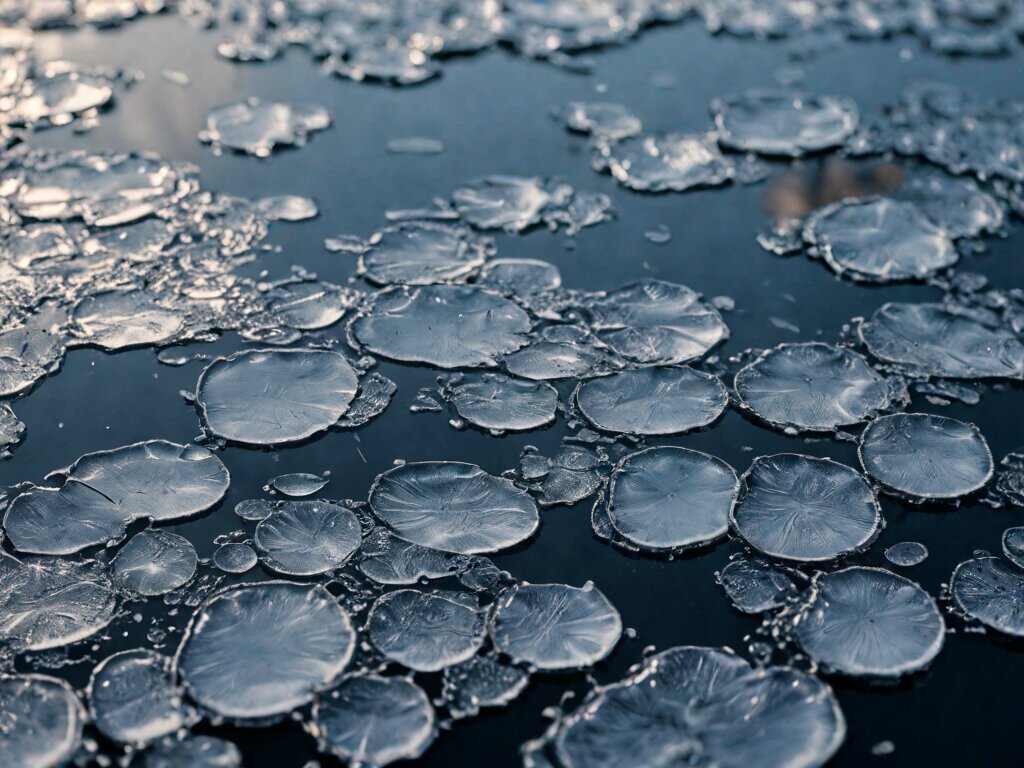
Start with grade, because thickness alone is a lie. Two kinds of ice matter. The good stuff is kärnis — core ice, the black or blue transparent ice that freezes downward from still water in cold air. It’s a single crystal structure, and you can see the frozen methane-bubble discs stacked metres below your blades. The bad stuff is stötis — snow-ice, the opaque white layer that forms when slush or flooded snow refreezes. It’s full of trapped air, and rule-of-thumb it carries roughly half the load of clear ice at the same thickness. So a reading of “eight centimetres” is meaningless until you know which eight centimetres you’re standing on.
Now the number. Ice fails in bending, like any flat plate, and a plate’s load-bearing capacity scales with the square of its thickness. That gives the field formula skaters actually use — Gold’s rule, in metric:
P (kg) ≈ 5 × h²      (h in cm, clear blue ice)

h = 4 cm  →  P ≈  80 kg   single skater, moving, spread load
h = 5 cm  →  P ≈ 125 kg   a person plus pack, cautiously
h = 7 cm  →  P ≈ 245 kg   a small group, spaced out
Four centimetres of clear ice is the widely cited floor for one person on foot. Halve every one of those numbers for snow-ice, and understand the formula assumes cold, sound, unfractured ice — it says nothing about the rotten grey stuff over a spring inlet.
Which is where the ispik — the ice pole — earns its keep. You skate holding it low and ahead, and every stride or two you drive the steel tip down in one committed jab. The cadence isn’t decoration; you are sampling the ice you are about to load, continuously, because the ice behind you already passed its test by not swallowing you.
If a single firm strike of the pole punches through, the ice is too thin — and you are already standing one stride too close to it.
That “one strike” threshold is the whole discipline in a sentence. You never need a second jab to confirm bad ice. On good kärnis the tip rings and skips off; on marginal ice it thuds and dimples; through stötis it pushes with a wet crunch and you stop, turn ninety degrees, and leave. The pole reads the surface the way a canoe forces you to read current — inlets, outlets, narrows, and anything with reeds standing through it, because the vegetation conducts warmth up and rots the ice around it. Bridges, springs, and the dark seam of a pressure ridge are all thin for the same reasons moving or warm water is thin.
Two facts I filed for the speed I’m chasing later. First, snow is not a blanket you can trust — it insulates the ice below from the cold air, so a fresh dump can thin what it covers while hiding it. Second, there’s a genuine trap that ties straight back to the iceboat: a moving load sets off flexural-gravity waves in the sheet, and near a critical speed those waves stack up under you. Ice that holds you standing can fail you at pace. “Safe when still” and “safe at speed” are two different questions, and I’d been conflating them on the boat.
And if the reading fails anyway: the ice claws (isdubbar) live on a cord around your neck, not in a zipped pocket you’ll never open with dead hands. You don’t climb out — you kick your legs flat to the surface, drive the spikes in, haul horizontally, and roll away from the hole to spread your weight across ice you haven’t broken yet.
I sounded a two-hundred-metre line across a bay this morning and did not fall in, which is a lower bar than it sounds and a fairer test of the method than of me. The runners on the iceboat let go because I couldn’t read the surface. Today I had a pole, a formula, and a rule for exactly one strike, and the ice told me things in order instead of all at once at the moment of the spin.