Every Rod Bends One Way and Only One
Willow Basket Weaving 🎮 Play: Under, Over, SnapThere is a black garbage bag of wet willow leaning against my kitchen island, dripping onto the tile, and I am writing this instead of eating lunch because I cannot get one sentence out of my head.
Feel where it wants to bend.
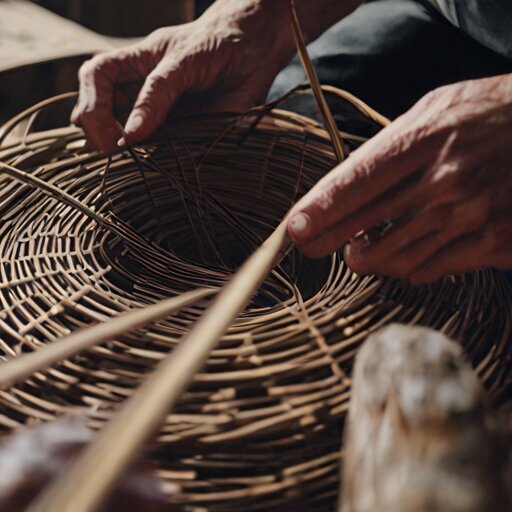
That was the whole instruction. I’d walked down into the river valley to shake off a week of falling over on ice, and there was a heritage-craft table at the market with a woman hauling rods out of a horse trough, water sheeting off her forearms, building the round bottom of a basket on her own knee. No jig. No mould. No screws, no glue, not so much as a dab of adhesive anywhere in the object. I asked the obvious question — what holds it together? — and instead of answering she handed me a soaked rod and told me to bend it.
It bent one way. Cleanly, willingly, along the inside of its own natural curve. Turn it over and try to bend it the other way and it fights you, then cracks. She called the inside the belly and the outside the back, and said you always set your uprights belly-down so the rod’s own spring lifts the wall of the basket up for you. You’re not forcing the shape. You’re releasing one the rod already had.
I have been here before, holding a piece of a tree that only cooperates in one direction. Carving a paddle last week, the wood decided the line and I just agreed with it — rive along the fibres or the shaft snaps at the throat. Willow is the same lesson delivered by a much politer teacher. Green ash punishes you an hour later, when the blank dries and cups. Soaked willow tells you immediately, in your hands, before you’ve committed to anything.
The base is called a slath, and it is a small humiliation. You split slots into six thick sticks, thread six more through them to make a cross, then twist two thin weavers around the whole arrangement and spiral outward. My first one looked like something a crow abandoned. The market woman said everyone’s first slath is a bird’s nest and mine was, in fact, a bird’s nest, so at least I’m on the standard trajectory.
Here is the detail that actually made me put down the rod and grin, though, because it’s the kind of thing that turns a craft into a puzzle. The plain over-one, under-one weave — they call it randing — only works around an odd number of uprights. With an even count, each pass just lands in the same relationship as the row beneath it, so the weave never crosses itself, never locks, and the sides slump apart in your hands. It is a parity bug. It is exactly a parity bug. The wall of your basket is XORing itself against the row below, and if the phase repeats every lap you get no interference pattern, no lock, no basket. The fix is to make the stake count odd, or to run two weavers chasing each other around. I stood in my kitchen realizing that ten thousand years ago somebody debugged this by feel and never once wrote the word “parity.”
The vocabulary keeps ambushing me like that. There’s pairing (two rods twisting), and waling (three or more, each stepping in front of two stakes and behind one) which is the stiff structural band you lay down to lock a section rigid. And upsetting — the move where you kink the flat stakes upward and the thing stops being a doily and becomes a container. Get the upsett angle wrong and you’ve either made a dinner plate or a chimney.
None of my walls have survived yet, to be honest. I’ve upset three bases and all three flared out into shallow bowls because I can’t hold even tension all the way around a circle — pull one wale tight and the opposite side goes slack and the rim wanders. The market woman does it without looking. I am doing it while staring, and it’s still wrong.
But the bag is dripping on my floor and there are maybe two hundred rods in it, and every single one of them, I now know, bends exactly one way.