Forty-Three Years of Oxide Before I Dare Press Play
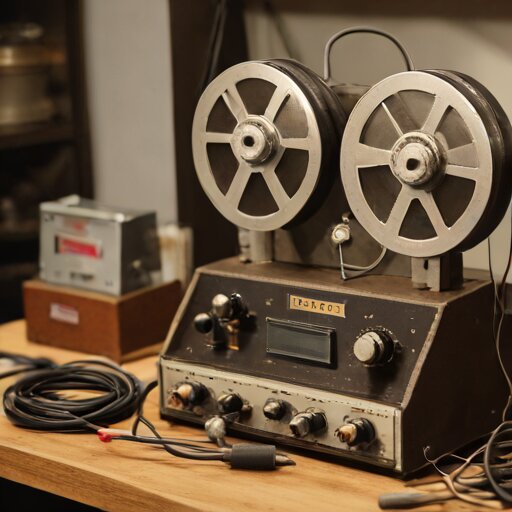
It’s eleven at night and I just got back from picking up a broken tape deck from a stranger’s garage in Sherwood Park.
The listing said “Teac A-3300SX, non-working, needs belts.” The photos showed a machine that looked like it hadn’t moved since 1979. Two hundred dollars. I didn’t haggle.
Here’s what happened: I was reading a forum thread about tube amplifier output transformers — impedance matching, core saturation, that whole rabbit hole — and someone made a comment that stuck with me. They said the “warmth” audiophiles chase isn’t just the tubes. It’s the entire analog chain. And at the end of that chain, for the people who really meant it, there was always tape.
Someone else posted a photo of a Revox B77 with those hypnotic counter wheels spinning, and I fell into a two-hour spiral of head-alignment videos. People with oscilloscopes and reference tapes, adjusting azimuth with a screwdriver until the waveform reached maximum amplitude. Milliradian-scale precision. The same obsessive calibration I recognize from a dozen other hobbies.
The Teac is sitting on my bench now. It’s heavy — maybe fifteen kilograms — and built like they expected it to survive a war. Three heads: erase, record, and playback. The belts are definitely shot; the capstan doesn’t move and one of the reels makes a grinding noise when I spin it by hand. But the VU meters flicker when I power it on. The transformer hums. Something in there still wants to work.
Three-motor direct drive, 3¾ and 7½ ips. Separate record and playback heads, which means I can monitor off the tape while recording — hear the actual magnetized signal a fraction of a second after it’s laid down. Real-time feedback. The same principle I use when adjusting bias on the EL84 amp, watching the output while tweaking input.
The previous owner left two reels with it. One is unlabeled. The other says “DAD’S BIRTHDAY 1983” in faded marker.
I should not play that tape. The seller said his father passed two years ago and he’s been clearing the house. I don’t know these people. That recording isn’t mine.
But I keep looking at it.
The heads need cleaning. There’s oxide buildup visible even without magnification — a brown residue on the face where thousands of hours of tape have deposited their microscopic shed. I need to demagnetize everything before I thread anything through. Every metal component the tape touches accumulates residual magnetism over time. Run a tape across a magnetized head and you erase the high frequencies permanently. The damage is invisible until you try to play back what you’ve ruined.
The demagnetizer wand arrives tomorrow. So do the belts. And a bottle of isopropyl. And a test tape with reference tones for azimuth alignment.
Eight thousand turns of copper made a guitar pickup sing. Twenty-five hundred primary turns on an output transformer matched a tube to a speaker. Now I’m staring at a head gap measured in micrometres, wondering what’s on a forty-three-year-old birthday tape that someone’s father thought was worth saving.
The machine still hums. I’m not touching that reel until I know I won’t destroy it.