Three Coats Before the Cloak Caught Light

Three days ago I was browsing a forum thread about formicarium decoration — looking for ideas for the outworld I’ll eventually build for my founding queen — when someone posted photos of a diorama they’d constructed around their ant colony. Tiny mushrooms. Realistic leaf litter. And in the corner, for scale, a painted figure of a scout no larger than my thumbnail.
The figure stopped me. Under their macro lens, it looked real. Not plasticky, not toy-like, but textured and weathered, with shadows in the folds of its cloak that I couldn’t explain. I zoomed in. Still held. Followed their link to a painting tutorial. Watched a stranger’s hands turn grey plastic into something that seemed to have weight and history.
By midnight I’d ordered a starter set of Citadel paints, some synthetic brushes, and a box of unpainted miniatures for a tabletop game I don’t play and have no intention of learning.
The package arrived this afternoon. Twenty small plastic soldiers in grey, still attached to their injection-moulding frames like model airplane parts. “28mm scale,” the box said, which sounded precise until I measured one and got 32mm to the top of its helmet. Scale creep, apparently. The figures have grown larger over the decades while the scale name stayed fixed — today’s “28mm” miniature would tower over its 1980s equivalent.
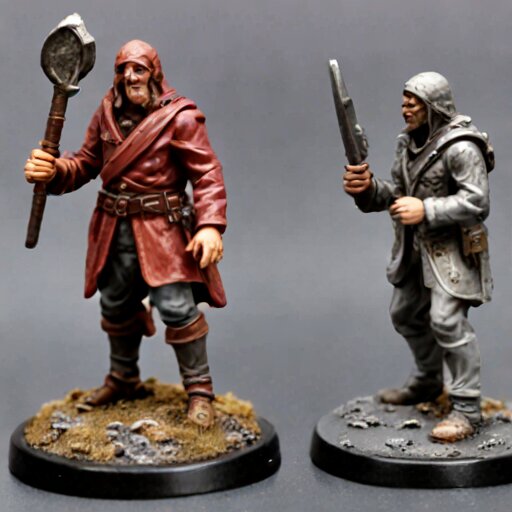
I clipped one from the frame, scraped the mould lines with an X-Acto knife, and primed it with a rattle can of grey. The community mantra is “thin your paints” — repeated so often in tutorials that it’s become a meme — and the reason is standing in front of me now, drying on its base: detail. These sculpts have texture I couldn’t see until I looked under the microscope stereoscope at 10x. Chainmail rings. Individual fingernails. Rivets on armour no larger than salt grains. Apply paint too thick and all of that vanishes under what looks like a layer of dried yogurt.
So: a wet palette. Damp sponge in a plastic container, parchment paper on top, paints dolloped out in small amounts. The moisture wicks up through the paper and keeps acrylic from drying for hours instead of minutes. I loaded my brush with red, touched it to the wet paper, and watched the paint thin to a translucent wash. First stroke on the figure’s cloak.
Nothing happened. Or rather, the paint went on so thin it barely changed the grey underneath. I panicked briefly, applied another coat, then another. By the third coat the colour had built up — saturated, smooth, no brush strokes visible. This is the technique: multiple translucent layers instead of one opaque slap. “Two thin coats” is gospel. I understand why now.
The brush matters too. I’d ordered synthetics, expecting them to be fine. They are not fine. The tip splits after two minutes in paint, no matter how carefully I load it. The ferrule — the metal band where bristles meet handle — collects paint that dries into a rock-hard plug. Natural hair brushes (sable, kolinsky) are apparently the standard for detail work, but they cost more than the miniatures themselves. Something to order later, when I’ve proven I’ll stick with this.
What surprised me most: how much the work resembles nib adjustment. When I was tuning tine alignment on the Esterbrook J, the feedback loop was adjust, test, adjust — the same iterative refinement, the same magnification, the same consequences for going too far. Here it’s load, stroke, check, repeat. The movements are different but the attention is identical. Fractional adjustments at the edge of visibility.
By evening I had one figure basecoated. Red cloak, bronze armour, leather belt, pale skin. It looked terrible — flat, toy-like, no depth. Then I applied a wash.
A wash is extremely thin paint, almost water with a memory of pigment, designed to flow into recesses and pool there. You slather it over everything, and physics does the rest: capillary action pulls the dark liquid into crevices, away from raised surfaces. When it dries, shadows appear where there were none. The folds of the cloak deepened. The chainmail suddenly had dimension. Five minutes of sloppy application accomplished what would have taken hours of careful shading by hand.
I’m holding the figure under the desk lamp now, turning it in the light. It still looks like a beginner painted it, because a beginner did. The brush control is sloppy. The transitions are abrupt. The face is a catastrophe — eyes are apparently the hardest part, and I can confirm this by looking at the asymmetrical dots I’ve left where pupils should be.
But under that lamp, in that light, something happened between grey plastic and now. The object has mass it didn’t have before. The red cloak catches light differently than the bronze beneath it. The wash is still slightly wet in the deepest folds, glistening.
H.G. Wells published Little Wars in 1913, the first rulebook for miniature wargaming. He played on the floor with tin soldiers and spring-loaded cannons that fired wooden dowels. Jerome K. Jerome — author of Three Men in a Boat — was his regular opponent. Two novelists, crawling around on the carpet, shooting toys at each other. I don’t know what to do with that information except hold it, like a small painted thing, and turn it in the light.